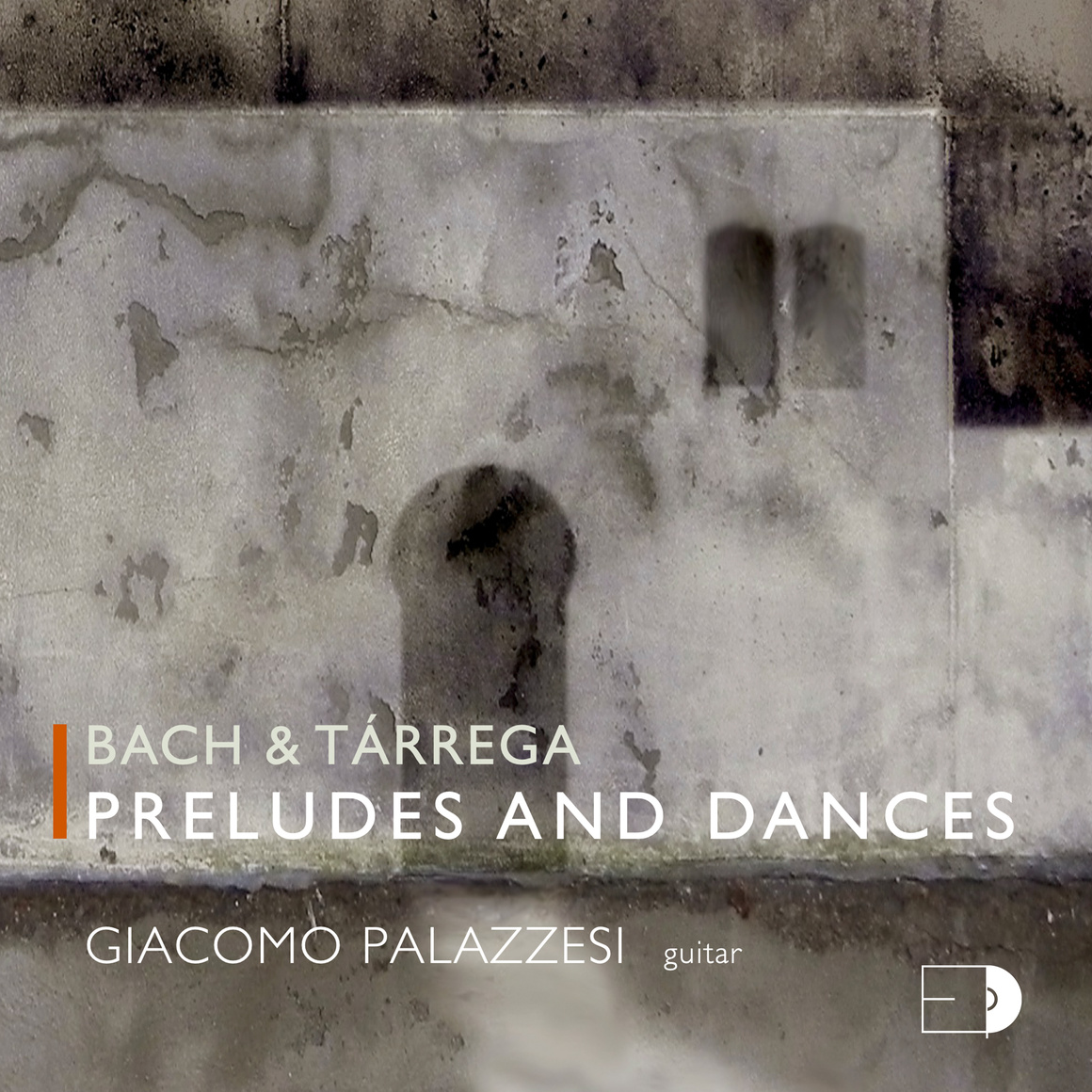
Johann Sebastian Bach · Francisco Tárrega · Extended Place, 2018
Bach & Tárrega: Preludes and Dances
Giacomo Palazzesi
AscoltaListenTracklist
Johann Sebastian Bach
- Cello Suite No. 2 in D minor, BWV 1008: I. Prélude
- Cello Suite No. 2 in D minor, BWV 1008: II. Allemande
- Cello Suite No. 2 in D minor, BWV 1008: III. Courante
- Cello Suite No. 2 in D minor, BWV 1008: IV. Sarabande
- Cello Suite No. 2 in D minor, BWV 1008: V. Menuets
- Cello Suite No. 2 in D minor, BWV 1008: VI. Gigue
Francisco Tárrega
- Preludio in D minor “A Mi Buen Amigo D. Francisco Corréll”
- Preludio in A minor “A Mi Queridísimo Discípulo Miguel Llobet”
- Preludio in D minor “Oremus”
- Preludio in E major “Al ilustre Dr. Walter Leckie”
- Preludio in D minor “Endecha”
- Preludio in A minor
- Preludio in F-sharp minor
Johann Sebastian Bach
- Präludium, Fugue und Allegro, BWV 998: I. Präludium
- Präludium, Fugue und Allegro, BWV 998: II. Fugue
- Präludium, Fugue und Allegro, BWV 998: III. Allegro
Le composizioni di Bach sono arrangiate da Giacomo Palazzesi.Bach’s compositions are arranged by Giacomo Palazzesi.
Durata complessivaTotal time: 51:14
CreditiCredits
- InterpreteInterpreter
- Giacomo Palazzesi — chitarraGiacomo Palazzesi — guitar
- Registrazione del suonoSound engineering
- Andrea Lambertucci
- Missaggio e masteringMixing & mastering
- Andrea Lambertucci
- RegistratoRecorded
- 30 e 31 agosto 2016, Palazzo Mestica, Apiro (MC)30 & 31 August 2016, Palazzo Mestica, Apiro (MC), Italy
Note di copertinaLiner notes
A proposito di Johann Sebastian Bach e delle Suites per Violoncello, non posso non pensare alla Sarabanda in Do minore della quinta suite che in Sussurri e grida dà voce alla visione della Pietà bergmaniana. Questo momento di cinema si sedimenta nella suite e, nel mio modo di intendere, entra a pieno regime nel novero delle interpretazioni date, si aggiunge ovvero alle stratificazioni di significati possibili di cui è fatta la storia di una composizione. Sono stato suggestionato da questa immagine e non nascondo di ritenerla all’origine del mio lavoro sulla Seconda Suite. Mi è parso che Bergman gettasse una luce per me inedita su tutto il corpus delle suites, e che quelle immagini facessero tornarequella musica a parlare di umana passione. «Questa musica perdona noi poveri diavoli e ci promette una nuova felicità, piange per noi con tutta l’anima. Wir setzen uns mit Tränen nieder, con essa, per essa», scrive Hans Werner Henze nell’autobiografia Canti di viaggi. Ho affrontato la musica di Bach di questa incisione, e specialmente questa suite, con la passione del povero diavolo che si affida a alla promessa di felicità bachiana. Ad Hopkinson Smith ho rubato molte delle armonizzazioni ed esplicitazioni del contrappunto realizzate nella voce di basso o nelle voci interne. È stato un passaggio essenziale lo studio della sua visione bachiana, e ho ritenuto di non dover aggiungere nulla a molte sue realizzazioni. Un’altra strada, e totalmente diversa, ho percorso riguardo all’uso degli abbellimenti. Totalmente mio è poi il tentativo di adattare e di rendere chitarristiche tutte le soluzioni musicali, sia originali di Bach, che di Bach/Smith, o di Bach/Palazzesi. Ovvero trascriverle.
Continua a leggereRead more RiduciShow less
Il Preludio, Fuga e Allegro è una composizione – che già è atipica nell’accostamento e nel numero dei movimenti – per strumento a tastiera che, per vari malintesi storici, ci illude(va) essere stata concepita per il liuto. Basta questo per conferirle il primato di una diffusione, nei programmi dei chitarristi, senza pari. Proprio questa diffusione – cioè la sedimentazione di una quantità di interpretazioni che, non propriamente ispirate da alcuna esigenza espressiva, creano il terreno fertile per il dogma – rappresenta a mio avviso l’ostacolo più grande per chi intenda confrontarsi con quest’opera. Chi ascoltasse questo lavoro conoscendo il brano troverà una deviazione dalle strade battute. Non è decisione presa a tavolino, o vezzo. È al contrario un approdo di un percorso che questo trittico ha intrapreso nella mia immaginazione, negli anni il tactus è andato via via rallentando fino a diventare lente di ingrandimento per frammenti polifonici sempre più piccoli. Questo ha portato a un’idea di omogeneità della pulsazione ritmica a unione dei tre movimenti, e al guardare a qualcosa che in quella musica mi sembra possibilità esclusiva della chitarra: la resa del gioco di luci e ombre delle voci interne. C’è inoltre un fatto casuale, che avrei potuto addurre a motivazione razionale e storica per ciò che riguarda la scelta del tempo, ma sarebbe un’aggiunta a posteriori di significato. Qui la scrivo appunto come fatto casuale, aneddoto curioso, o soprattutto come evento naturale che spiega l’origine e il significato di una prassi; e mi riferisco al legame tra il pulsare ritmico e il battito cardiaco del musicista, a quelle motivazioni cioè che esprimono l’origine del termine e del concetto di tactus. Casuale è l’aver pensato dopo che il mio cuore a riposo batte anch’esso quarantasei pulsazioni ogni minuto.
Ho registrato tutto il disco, e quindi anche il Preludio, Fuga e Allegro, rifiutando l’idea di registrare passaggi e porzioni di brani decontestualizzati dal loro naturale divenire musicale; l’editing è ridotto al minimo essenziale e pratico e si limita alla selezione, alla scelta avendo come basi queste grandi sezioni formalmente compiute. Nel caso specifico di quest’opera, ho accettato che la lente dei tempi dilatati mettesse in risalto eventuali imperfezioni generate dalla tipologia di incisione e quindi dalle caratteristiche proprie dello strumento e delle corde. Le accetto e mi illudo che questo rappresenti il mio modo di essere interprete, il presupposto per lasciar dire al discorso musicale qualcosa che può verificarsi soltanto nel discorso compreso nel suo contesto.
Francisco Tárrega fu chitarrista, compositore e instancabile trascrittore. I suoi Preludi esprimono il lato puramente speculativo e immaginifico del suo essere compositore. Quasi tutti arrecano una dedica, la più nota delle quali è nel preludio in La menor al suo queridisimo discipulo Miguel Llobet. Non abbiamo notizia di concerti in cui Tárrega abbia impaginato i suoi preludi. Anche per questo motivo, per me, restano testimonianza di una ricerca di semplice purezza, e oserei dire del grado massimo di rigore che Tárrega arrivò a pretendere dal suo essere compositore. Purezza come sintesi di tutto quanto egli aveva compreso dal suo essere trascrittore, dai suoi studi di composizione e dal suo essere chitarrista. E compendio di tutto ciò che, per lui e nella sua idea di chitarra, poteva solo essere necessario, negando la presenza di ogni altro elemento superfluo. Nulla rimanda al folklore, al chitarrismo popolare, e nulla è ostentazione di un gesto chitarristico fine a sé stesso, niente esiste senza essere chiamato a rispondere a un’urgenza musicale. Ma forse urgenza è concetto da usare con cautela nei confronti di Tárrega. Josefina Robledo ospitò in casa il suo maestro e con tutta la famiglia si occupò anche di accudire il chitarrista afflitto da problemi alla vista. È lei – e lo fa quindi da un punto di osservazione privilegiato – a descriverci un uomo geniale ma dall’indole semplice e generosa; nel suo essere musicista, nella pratica quotidiana con lo strumento, nel rapportarsi alle sue idee e scoperte, guidato da un approccio che la Robledo avrebbe poi definito francescano. Non fu quindi intellettuale-artista fortemente radicato nella sua epoca, come lo diventò presto il suo allievo Miguel Llobet, che nella chitarra intuiva qualcosa di cui forzare i confini per adattarli alla poderosa immaginazione di interprete e compositore che era. In Tárrega c’è invece un rifiuto consapevole di rapportarsi con il mondo intellettuale, in favore di uno stile esistenziale, e quindi musicale, poeticamente semplice ma intenso nel sentire tanto da sfociare in una sorta di misticismo artistico: concluse la sua vita ritirandosi in sé stesso, alla ricerca del suono. Arrivò a vedere nella chitarra, rispettandone i limiti fino all’ossessione – questa è la mia idea – qualcosa di infinitamente chiuso da contenere il segreto infinitamente grande dell’esistenza. Il suono, avant toute chose.
Lo strumento che uso nella registrazione è stato costruito da Gabriele Lodi, ed è frutto di una scommessa e soprattutto di una ricerca del liutaio e mia sulla possibilità di proporre, oggi, uno strumento realmente costruito seguendo criteri della liuteria dei primi due decenni del ‘900: non è uno studio sul passato, o potrebbe esserlo nella misura in cui accettiamo che lo studio del passato sia un modo per rivolgersi al nostro presente.
La chitarra è dotata di tornavoz, che permette di esaltare le note fondamentali dei suoni emessi; filtrandoli quindi da tutto ciò che non risulti fondamentale all’essenza del suono stesso; musicalmente questo – e soprattutto – ha condizionato fortemente le direzioni interpretative che ho potuto prendere in queste registrazioni.
Dal punto di vista dell’incisione, della realizzazione discografica in ogni sua forma, questo lavoro è stato ideato e prodotto materialmente da Andrea Lambertucci. Insieme abbiamo condiviso il tentativo di tenere in equilibrio qualcosa che fosse riproducibile e conservasse la natura estemporanea del naturale farsi musica. Ne è nato il fragile vaso di suoni (come definiva Florenskij il fragile vaso della parole umane), che è l’incisione qui proposta all’ascolto.
Giacomo Palazzesi
domenica, 30 luglio 2017
Whenever I think about Johann Sebastian Bach and the Cello Suites, I cannot help but think of the Sarabande in C minor from the Fifth Suite, which in Cries and Whispers gives voice to Bergman’s vision of the Pietà. This moment in cinema settles into the suite and, as I understand it, enters fully into the body of interpretations that have been given; in other words, it adds itself to the layers of possible meanings that make up the history of a composition. I was deeply affected by this image, and I have no hesitation in considering it the origin of my work on the Second Suite. It seemed to me that Bergman cast a light, new to me, over the entire corpus of the suites, and that those images made the music speak once more of human passion. “This music forgives us poor devils and promises us a new happiness; it weeps for us with all its soul. Wir setzen uns mit Tränen nieder, with it, for it,” writes Hans Werner Henze in his autobiography Canti di viaggi. I approached Bach’s music on this recording, and this suite in particular, with the passion of the poor devil who entrusts himself to Bach’s promise of happiness. From Hopkinson Smith I took many of the harmonisations and realisations of the counterpoint in the bass and inner voices. Studying his vision of Bach was an essential step, and I felt there was nothing to add to many of his solutions. I followed another, entirely different path in the use of ornaments. Entirely my own, finally, is the attempt to adapt and make idiomatic to the guitar every musical solution—whether Bach’s, Bach/Smith’s or Bach/Palazzesi’s. In other words, to transcribe them.
Read more Show less
Prelude, Fugue and Allegro is a composition for keyboard—already unusual in its combination and number of movements—which, through various historical misunderstandings, led us to believe that it had been conceived for the lute. That alone has ensured it an unparalleled presence in guitarists’ programmes. Yet this very diffusion—the accumulation of a multitude of interpretations which, not always prompted by an expressive need, create fertile ground for dogma—is, in my view, the greatest obstacle facing anyone who wishes to engage with the work. Listeners already familiar with the piece will find this performance a departure from the well-trodden path. This was neither a calculated decision nor an affectation. On the contrary, it is the destination of a journey that this triptych has undertaken in my imagination: over the years, the tactus has gradually slowed until it became a magnifying glass for ever smaller polyphonic fragments. This led to the idea of a uniform rhythmic pulse binding the three movements, and to a focus on something in the music that seems to me a unique possibility of the guitar: revealing the play of light and shadow among the inner voices. There is also a chance fact which I might have offered as a rational and historical justification for my choice of tempo, but that would have been an after-the-fact addition of meaning. I mention it here precisely as a chance occurrence, a curious anecdote, or above all as a natural event that explains the origin and meaning of a practice: the connection between rhythmic pulsation and the musician’s heartbeat, the very reasons embodied in the origin of the term and concept of tactus. It was only afterwards that I happened to realise that my own resting heart also beats forty-six times a minute.
I recorded the entire album—including Prelude, Fugue and Allegro—while rejecting the idea of recording passages and portions of works detached from their natural musical unfolding. Editing was kept to a practical minimum and was limited to selecting among these large, formally complete sections. In this work in particular, I accepted that the magnifying lens of expanded tempos might bring out imperfections arising from the recording method and therefore from the inherent characteristics of the instrument and its strings. I accept them, and like to think that this represents my way of being a performer: the premise for allowing the musical discourse to say something that can occur only when that discourse is heard within its context.
Francisco Tárrega was a guitarist, composer and tireless transcriber. His Preludes express the purely speculative and imaginative side of his work as a composer. Almost all bear a dedication, the best known being that of the Prelude in A minor to his queridisimo discipulo Miguel Llobet. We have no record of concerts in which Tárrega programmed his preludes. For this reason too, to me they remain the testimony of a search for simple purity—and, I would venture, of the highest degree of rigour that Tárrega ever demanded of himself as a composer. Purity as a synthesis of everything he had understood through his work as a transcriber, his studies in composition and his life as a guitarist; a compendium of all that, for him and within his conception of the guitar, could alone be necessary, excluding every superfluous element. Nothing points towards folklore or popular guitar traditions, and nothing is the display of a guitaristic gesture for its own sake; nothing exists unless called upon to answer a musical necessity. Yet “necessity” is perhaps a concept to be used with caution in relation to Tárrega. Josefina Robledo welcomed her teacher into her home and, together with her family, helped care for the guitarist as his eyesight deteriorated. It is she—from this privileged vantage point—who describes a man of genius, yet simple and generous in nature; a musician whose daily practice with the instrument, and whose relationship with his ideas and discoveries, was guided by an approach that Robledo would later call Franciscan. He was therefore not an intellectual-artist deeply rooted in his age, as his pupil Miguel Llobet soon became—Llobet, who sensed in the guitar something whose boundaries could be stretched to accommodate his powerful imagination as performer and composer. Tárrega, by contrast, consciously declined to engage with the intellectual world, favouring an existential and therefore musical style, poetically simple yet so intense in feeling that it flowed into a kind of artistic mysticism: he ended his life by withdrawing into himself, in search of sound. He came to see in the guitar, respecting its limits almost to the point of obsession—this is my view—something infinitely enclosed, capable of containing the infinitely vast secret of existence. Sound, avant toute chose.
The instrument I use on this recording was built by Gabriele Lodi. It is the result of a wager and, above all, of research undertaken by the maker and myself into the possibility of presenting, today, an instrument genuinely built according to the principles of guitar making in the first two decades of the twentieth century. It is not a study of the past—or it may be so only insofar as we accept that studying the past is a way of addressing our present.
The guitar is fitted with a tornavoz, which enhances the fundamental pitches of the sounds it produces, filtering out everything that is not essential to the essence of the sound itself. Musically—and above all—this strongly shaped the interpretative directions I was able to take in these recordings.
From the standpoint of the recording and of every aspect of its realisation, this project was conceived and materially produced by Andrea Lambertucci. Together we pursued the attempt to hold in balance something that could be reproduced while preserving the extemporaneous nature of music as it naturally comes into being. The result is the fragile vessel of sounds presented here for listening—as Florensky called human words a fragile vessel.
Giacomo Palazzesi
Sunday, 30 July 2017