Tracklist
Manuel M. Ponce
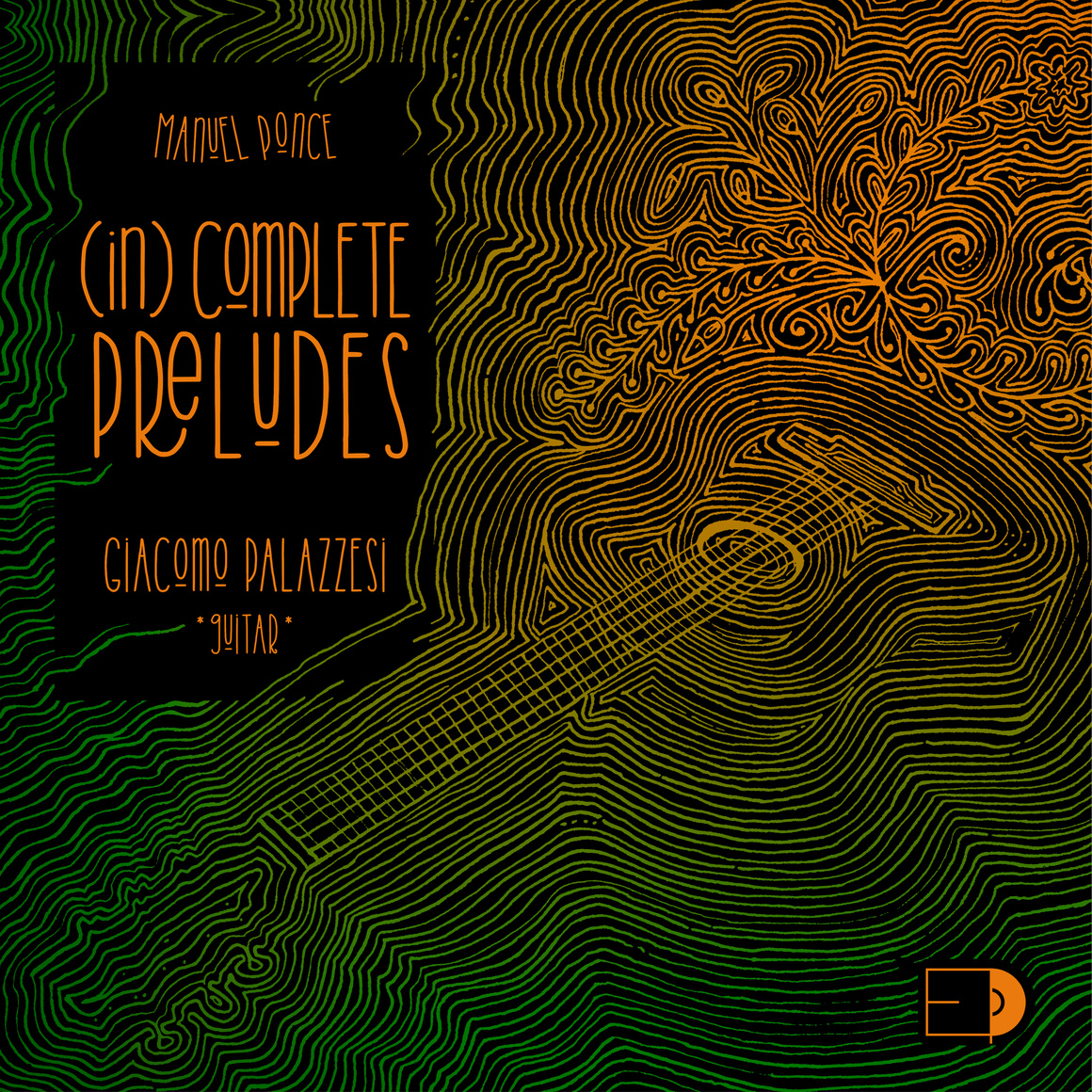
24 Guitar Preludes24 Guitar Preludes
- Prelude in C major
- Prelude in A minor
- Prelude in E minor
- Prelude in D major
- Prelude in B minor
- Prelude in A major
- Prelude in F♯ minor
- Prelude in E major
- Prelude in C♯ minor
- Prelude in B major
- Prelude in G♯ minor
- Prelude in F♯ major
- Prelude in D♯ minor
- Prelude in D♭ major
- Prelude in B♭ minor
- Prelude in A♭ major
- Prelude in F minor
- Prelude in E♭ major
- Prelude in C minor
- Prelude in B♭ major
- Prelude in G minor
- Prelude in F major
- Prelude in D minor
Durata complessivaTotal time: 27:25
CreditiCredits
- InterpreteInterpreter
- Giacomo Palazzesi — chitarraGiacomo Palazzesi — guitar
- ProduzioneProduced by
- Alessandro Stella
- Registrazione del suonoSound engineering
- Tommaso Cancellieri
- Missaggio e masteringMixing & mastering
- Tommaso Cancellieri
- RegistratoRecorded
- 27 aprile 2021, Abbey Rocchi Studios, Roma27 April 2021, Abbey Rocchi Studios, Rome
- Copertina e graficaCover & artwork
- Javier G. Borbolla
Note di copertinaLiner notes
L’epistolario Manuel Ponce – Andrés Segovia, prima pubblicato da Orphée in un’edizione curata da Miguel Alcázar, e poi fatto ritirare dalle stampe dagli eredi del chitarrista, ci mostra come la genesi della quasi totalità delle opere per chitarra di Manuel Ponce nasca su richiesta di Andrés Segovia. Inoltre appare evidente dalle lettere che quella con il compositore messicano fu una delle più sincere e intense amicizie del chitarrista: al queridisimo Manuel Segovia confiderà la fine del suo primo matrimonio, la fuga da Barcellona, gli esilî americani a New York e Montevideo, le sue opinioni politiche sui rivoluzionari spagnoli e sui rivoluzionari messicani, le invettive contro compositori e interpreti che le rivoluzioni le avevano in qualche modo benaccolte: Pau Casals per la Spagna, e Carlos Chavez per il Messico, solo per citarne due illustrissimi.
È questo il clima in cui, negli anni ’20 (probabilmente 1928-1929) a Parigi, Manuel Ponce compone i 24 Preludi – uno per ogni tonalità – per Andrés Segovia: il chitarrista aveva chiesto a Ponce di scrivere un ciclo di 24 preludi, uno per ogni tonalità, per poi pubblicarli nella sua collezione di musica per chitarra, edita da Schott.
Continua a leggereRead more RiduciShow less
Quando Segovia abbandonò il proposito di un ciclo integrale selezionò 12 dei 24 Preludi, e li pubblicò - dopo averli abbondantemente revisionati e modificati (compresi cambi di tonalità) - nell’edizione Schott che li rese famosi. Per avere idea completa del lavoro che fece Manuel Ponce bisognerà aspettare l’edizione Tecla, anno 1981, basata sul manoscritto ritrovato a Città del Messico e curata da Miguel Alcázar. Questa edizione getta una luce completamente nuova sui Preludi, rendendone evidente la natura ciclica (non si può non pensare ai Preludi di Chopin), e mettendo in luce l’importanza delle diverse tonalità intese come stanze da attraversare: ogni stanza un colore, ogni colore un modo di concepire la forma, di cantare i temi, in una continua alternanza di idiomaticità strumentale e pensiero astratto, di rigore e libertà, di temi popolari e forme contrappuntistiche rigorose.
Quando ho deciso di affrontare questa incisione ho avuto la fortuna di potermi avvalere del manoscritto ritrovato a Città del Messico da Miguel Alcázar, e che Angelo Gilardino, quando ero suo allievo, mi aveva fornito.
Dallo studio del manoscritto sono emerse due questioni a mio avviso ancora aperte. La prima era la curiosa progressione delle tonalità nella successione presentata da Manuel Ponce: nei fogli manoscritti l’autore procede nel consueto ordine del sistema tonale a partire dalla chiave di Do maggiore (e relativa tonalità di La minore) fino alla coppia Re bemolle maggiore-Si bemolle minore; da lì passa alle chiavi di Fa maggiore-Re minore, Si bemolle maggiore-Sol minore, Mi bemolle maggiore-Do minore, La bemolle maggiore-Fa minore.
Nell’edizione Tecla del 1981 Alcázar modifica questa successione procedendo secondo il circolo delle quinte e terminando quindi con il Preludio in re minore (Chant populaire espagnol). Cambierà poi idea, e nel volume Obra complete para guitarra de Manuel M. Ponce / de acuerdo a los manuscritos originales, edito da Conaculta nel 2000, l’ordine del compositore è fedelmente ristabilito.
In questa incisione ho deciso di non tener fede alla sequenza del manoscritto e di rispettare la naturale progressione del circolo delle quinte, è stata una scelta naturale e compiuta in una fase avanzata di studio dell’opera, dopo aver più volte eseguito l’intero ciclo dei preludi in entrambe le successioni. Da un lato perché il manoscritto si presenta come una bozza corretta da presentare ancora in una bella copia, e ne ho derivato il pensiero che il compositore potesse comporre in un ordine comodo a lui, dando poi per scontata la disposizione convenzionale in bella e per la successiva edizione; dall’altro perché mi è parso che Manuel Ponce volesse tratteggiare un percorso preciso, dove si raggiunge un culmine di tensione e speculazione nelle tonalità lontane per poi riavvicinarsi, come in una parabola, fino all’abbandono completo del Chant populaire espagnol in Re minore. Per questo motivo ho fatto riferimento a una scelta naturale.
L’altro problema è di importanza musicologica notevole e riguarda l’assenza del preludio in Sol maggiore. Questo brano non è presente nel manoscritto, Miguel Alcázar ha ritrovato i testi di soli 23 preludi e ha deciso di rimpiazzare il vuoto del Preludio in Sol maggiore con un altro brano. Ho evitato di seguire questa scelta volendo considera l’assenza del Preludio in Sol maggiore una (non)testimonianza necessaria, una porta aperta varcata la quale la biografia irrompe nell’opera.
Macerata, 29 luglio 2022
The correspondence between Manuel Ponce and Andrés Segovia—first published by Orphée in an edition prepared by Miguel Alcázar, and later withdrawn at the request of the guitarist’s heirs—shows us that almost all of Manuel Ponce’s works for guitar originated in requests from Andrés Segovia. The letters also make clear that the Mexican composer was one of the guitarist’s most sincere and intimate friends. To his queridisimo Manuel, Segovia would confide the end of his first marriage, his flight from Barcelona, his years of exile in New York and Montevideo, his political views on the Spanish and Mexican revolutionaries, and his invectives against composers and performers who had in one way or another welcomed those revolutions—Pau Casals in Spain and Carlos Chávez in Mexico, to name only two of the most illustrious.
It was in this atmosphere that, in Paris in the late 1920s—probably 1928–29—Manuel Ponce composed the 24 Preludes, one in each key, for Andrés Segovia. The guitarist had asked Ponce to write a cycle of twenty-four preludes, one in every key, for publication in his Schott collection of guitar music.
Read more Show less
When Segovia abandoned the idea of a complete cycle, he selected twelve of the twenty-four Preludes and published them—in an edition that extensively revised and altered Ponce’s text, including changes of key—in the Schott volume that made them famous. A complete picture of Manuel Ponce’s work did not become available until the 1981 Tecla edition, based on the manuscript found in Mexico City and edited by Miguel Alcázar. That edition cast the Preludes in an entirely new light, revealing their cyclic nature—Chopin’s Preludes inevitably come to mind—and underscoring the importance of the different keys as rooms to be traversed: each room a colour, each colour a way of conceiving form and singing the themes, in a constant alternation between instrumental idiom and abstract thought, rigour and freedom, popular themes and strict contrapuntal forms.
When I decided to undertake this recording, I was fortunate to be able to consult the manuscript discovered in Mexico City by Miguel Alcázar, which Angelo Gilardino had given me when I was his student.
My study of the manuscript brought to light two questions that, in my view, remain unresolved. The first was the curious progression of keys in the sequence presented by Manuel Ponce. In the manuscript pages, the composer follows the customary order of the tonal system from C major—and its relative key of A minor—to the pair D-flat major and B-flat minor; from there he moves to F major and D minor, B-flat major and G minor, E-flat major and C minor, A-flat major and F minor.
In the 1981 Tecla edition, Alcázar altered this sequence to follow the circle of fifths, thus ending with the Prelude in D minor (Chant populaire espagnol). He later changed his mind and, in the volume Obra complete para guitarra de Manuel M. Ponce / de acuerdo a los manuscritos originales, published by Conaculta in 2000, the composer’s order was faithfully restored.
For this recording I decided not to follow the sequence of the manuscript, but instead to preserve the natural progression of the circle of fifths. This was a natural choice, reached at an advanced stage in my study of the work, after I had performed the entire cycle several times in both orders. On the one hand, the manuscript appears to be a corrected draft still awaiting a fair copy, which led me to think that the composer may have worked in an order that was convenient for him, taking for granted that the conventional sequence would be established in the fair copy and in the subsequent edition. On the other hand, it seemed to me that Manuel Ponce intended to trace a precise path: tension and speculation reach their culmination in the remote keys, then draw closer again, like a parabola, until the complete surrender of the Chant populaire espagnol in D minor. This is why I have described the decision as a natural choice.
The other problem is of considerable musicological importance and concerns the absence of the Prelude in G major. This piece is not found in the manuscript: Miguel Alcázar discovered the texts of only twenty-three preludes and chose to fill the gap left by the G-major Prelude with another work. I decided not to follow this solution, preferring to regard the absence of the G-major Prelude as a necessary piece of (non-)evidence—an open door through which biography breaks into the work.
Macerata, 29 July 2022